Download PDF The Word-Faith Controversy: Understanding the Health and Wealth Gospel
Having many extra times as well as have no suggestions to do something when vacation is extremely dull. In such time, you will most likely feel that you are tired of your tasks. Going outside or associating your friends might need more money. So, this is right to attempt connecting to the internet and also search for guide collection. If you intend to be established even in your holidays, you could use the precious collections of publications to review.
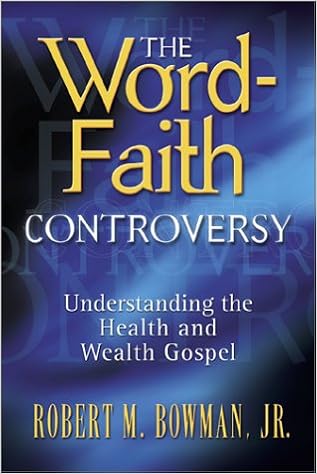
The Word-Faith Controversy: Understanding the Health and Wealth Gospel

Download PDF The Word-Faith Controversy: Understanding the Health and Wealth Gospel
Introducing a new hobby for other people may inspire them to join with you. Reading, as one of mutual hobby, is considered as the very easy hobby to do. But, many people are not interested in this hobby. Why? Boring is the reason of why. However, this feel actually can deal with the book and time of you reading. Yeah, one that we will refer to break the boredom in reading is choosing The Word-Faith Controversy: Understanding The Health And Wealth Gospel as the reading material.
For everybody, if you intend to start accompanying others to check out a book, this The Word-Faith Controversy: Understanding The Health And Wealth Gospel is much suggested. And also you have to get guide The Word-Faith Controversy: Understanding The Health And Wealth Gospel right here, in the web link download that we give. Why should be below? If you really want various other type of books, you will consistently discover them and also The Word-Faith Controversy: Understanding The Health And Wealth Gospel Economics, national politics, social, scientific researches, religious beliefs, Fictions, as well as more publications are provided. These readily available books are in the soft data.
The factor of many individuals chooses this The Word-Faith Controversy: Understanding The Health And Wealth Gospel as the recommendation discloses due to the demands in this day. We have some certain ways how the books exist. Starting from words choices, linked topic, as well as easy-carried language design, just how the writer makes this The Word-Faith Controversy: Understanding The Health And Wealth Gospel is really easy. But, it showcases the workaday that could affect you much easier.
The writer is actually smart to pick the words to make use of in making this book. The options of words are essential to produce a publication. It will certainly be proper to review by such certain societies. Yet one of the breakthroughs of this publication is that this book is really proper for every single society. You may not be afraid to know nothing after reading this publication. The Word-Faith Controversy: Understanding The Health And Wealth Gospel can assist you to locate several things after reading.
Is it God's will that believers be healthy, wealthy, and wise? Wise, definitely, but Robert M. Bowman questions those who teach a message of bodily health and financial prosperity through faith. In this balanced book, Bowman examines the word of faith movement by revealing the origins, teachers, and errors of this distortion of Christian doctrine. The faith healing and prosperity gospel aspects of the movement are what appeal to some and turn off others, causing a confusing and sometimes heated controversy. But the word of faith movement is, Bowman insists, "neither soundly orthodox nor thoroughly heretical." Using the Bible as his touchstone, Bowman helps readers sort through the controversy and distinguish acceptable Pentecostal teachings from distorted offshoots. He guides believers curious about the role of faith in healing and prosperity, and encourages charismatics to pursue a rich, mature, biblically sound Pentecostalism.
Your recently viewed items and featured recommendations
›
View or edit your browsing history
After viewing product detail pages, look here to find an easy way to navigate back to pages you are interested in.
Product details
Paperback: 254 pages
Publisher: Baker Pub Group; First Edition edition (September 1, 2001)
Language: English
ISBN-10: 0801063442
ISBN-13: 978-0801063442
Product Dimensions:
6 x 1 x 8.8 inches
Shipping Weight: 13.6 ounces
Average Customer Review:
3.9 out of 5 stars
13 customer reviews
Amazon Best Sellers Rank:
#554,862 in Books (See Top 100 in Books)
The book is insightful and gives a good background (orgin) to the movement. I really appreciate Bowman's approach to this subject by not attacking the movement in a bias manner. Bowman examines the pros and cons, gives his opinion in some instances, but basically allows the reader to form your own opinion based on the information provided.
I found the book to be a little uneven in its evaluation at times, but I do believe that it could be the most balanced in-depth analysis of Word Faith teachings in one book.
While I haven't read many books on the Word of Faith movement yet, I believe Robert Bowman's has to be one of the best ones out there. He takes a very balanced and systematic approach to dissecting the historical and theological traditions of the movement. He also does a great job--perhaps one of the best that I've ever seen in any critical work--of not interjecting his personal beliefs in with his analysis. While I'm sure his beliefs affect his analysis (as all of ours do), he does not offer social or personal commentary on his research. This is welcome and helps the reader come to his or her own conclusion.Of course the question at hand is whether or not the Word of Faith movement is based on some heresy. Bowman argues that the best of Word-Faith theology is grounded in the evangelical healing tradition, but that some of its specific (and signature) doctrines indeed cross the line of being unorthodox if not heretical. He argues that Word-Faith is not a cult, nor do its teachers intend it to be, but that its doctrines as formulated especially by Kenneth Copeland are leading massive numbers of Christians astray. He argues this point well through a number of chapters where he analyzes each doctrinal component as compared with Scripture, as does he weave in how his assessments differ from other commentators' (such as Hannegraff and DeArteaga).I think his more debatable and less well-argued points come in where he questions some of the faith statements of the larger Pentecostal-Charismatic community. While he is right to leave "no stone unturned" or allow any "sacred cows" to sneak in the back door, I found his biblical assessment of themes such as Christ's nature in the believer, the question of dominion over sickness, and other aspects of the Holy Spirit's indwelling to be more suspect. In no way is he hostile or polemical to charismatic theology per se, but his powerful exegesis prevalent in his other analyses (i.e. the Trinity) is wanting. I was less convinced to be worried about these aspects of the Word-Faith or larger charismatic community.Anyway, a great read on the subject. Very comprehensive and thoughtful. Takes some time to work through.
Dr. Robert Bowman is one of the best Christian apologetic researchers around. His books always contain numerous sources of information on whatever topic he addresses whether it is Mormonism or in this case the health and wealth gospel or more properly, the Word-Faith Movement.In this book, Dr. Bowman tackles the issues of the Word-Faith movement from their false teachings to many of their claims such as positive confession or hyper-prosperity. He does so in grace. I found Dr. Bowman's book not to be a negative attack on Word-Faith teachers but a biblical examination of the facts. I think we all should agree that no man is above the watchful eye of the inerrant Word of God (Hebrews 4:12-13). We should all submit fully our lives and doctrines to the test of Scripture (John 8:31-32; Acts 2:42; 1 Timothy 4:16; Titus 2:1; 2 Peter 1:16-21).Whether you are a pastor in the Word-Faith Movement, a Christian seeking to understand the Word-Faith Movement, or simply someone curious about this movement within Christianity, I would urge you to get this great book.
This is the best critical analysis of the Word of Faith (or Word-Faith) movement to date. Bowman, a non-charismatic, shows an acute awareness of the pertinent issues and seems familiar with not only the primary literature and tapes of the Word-Faith proponents but also it's critics and counter-critics (e.g., Bruno, DeArteaga, & Spencer). Contrary to the primary critics of the movement such as Hanegraaff, McConnell and Hunt, Bowman feels that the movement has its roots in the evangelical faith-cure movement of the late nineteenth century, not the metaphysical cults (New Thought, Christian Science, etc.). Nonetheless, he does qualify this by stating that "the possibility exists that the evangelical faith-cure movement and early Pentecostalism were also influenced in some respects by meta-physical thought" (pg. 82), although he leaves this possibility relatively unexplored in the book. Interestingly, contemporary New Thought authors Anderson & Whitehouse, in their book "New Thought: A Practical American Spirituality" (1995), also note the similar interest in healing between their movement and the evangelical faith-cure movement and, like Bowman (but unlike some critics), recognize the differences in world views (pantheism vs. Christian theism). It is also worth noting that they state that most of the leaders of the major New Thought groups existing today came from Traditional Christian backgrounds which didn't meet their needs, especially for healing. Apparently both movements expanded their interests to include not only physical health but also overall well-being and success (including wealth). From the evangelical faith-cure movement came the 20th century's Pentecostal & Charismatic movements, which included a revival of supernatural charismatic gifts, including speaking in other tongues (unknown languages) by the Holy Spirit.Bowman considers E. W. Kenyon to be the grandfather, not father, of the Word-Faith (W-F) movement because he considers it to be essentially a Pentecostal movement since the W-F movement's primary "father", Kenneth Hagin, was Pentecostal, unlike Kenyon (but he also considers William Branham and Oral Roberts to be contributing "fathers" to the W-F movement in various ways). He also thinks that Hagin contributed certain doctrines to the movement that Kenyon didn't teach. Bowman thinks the W-F movement is an extreme Pentecostalism, or a Pentecostalism "at it's worst". One must keep in mind, however, that there are various definitions of what constitutes "Pentecostal" and "Charismatic". Technically, the former is applied strictly to those who believe that speaking in other tongues is the sole "initial evidence" of the Baptism in the Holy Spirit. In other words, if one doesn't speak in tongues, then one HASN'T been baptized in the Holy Spirit. This is the position of classical Pentecostal denominations such as the Assemblies of God (A/G), the largest Pentecostal denomination in the world. Those who reject this position but still believe that speaking in tongues is for today, along with the other charismatic gifts of the Spirit, are generally categorized as "Charismatic". Kenneth Hagin was once affiliated with the A/G, but left the denomination to become independent or non-denominational. Although Hagin is a classical Pentecostal, I personally don't think that the "initial evidence" position of Hagin is integral to the W-F movement & its theology. There are many in the W-F movement that are Charismatic, not Pentecostal. Bowman occasionally uses a broader definition of "Pentecostal" than the more technical definition related to the "initial evidence" position which he considers a "hard-line view" (pg. 62), rejected by such men as F. F. Bosworth, author of "Christ the Healer".Bowman considers the W-F views on healing and prosperity to be the least problematic aspects of their theology (pg. 11), but I tend to think that their distinctive theology was formulated to reinforce the movement's views on healing and prosperity. The doctrines of healing and prosperity as available in this life through "faith" are the "positive" motivating force of the movement regardless of the distinctive aberrant theology just as they are the thrust of the New Thought movement with its "positive" message regardless of its pantheism and/or panentheism. It is not surprising that the New Thought authors noted above consider Norman Vincent Peale and Robert Schuller as promoters of some of New Thought's ideas on positive/possibility thinking although neither Peale nor Schuller is a pantheist or even a Pentecostal or Charismatic.
The Word-Faith Controversy: Understanding the Health and Wealth Gospel PDF
The Word-Faith Controversy: Understanding the Health and Wealth Gospel EPub
The Word-Faith Controversy: Understanding the Health and Wealth Gospel Doc
The Word-Faith Controversy: Understanding the Health and Wealth Gospel iBooks
The Word-Faith Controversy: Understanding the Health and Wealth Gospel rtf
The Word-Faith Controversy: Understanding the Health and Wealth Gospel Mobipocket
The Word-Faith Controversy: Understanding the Health and Wealth Gospel Kindle